


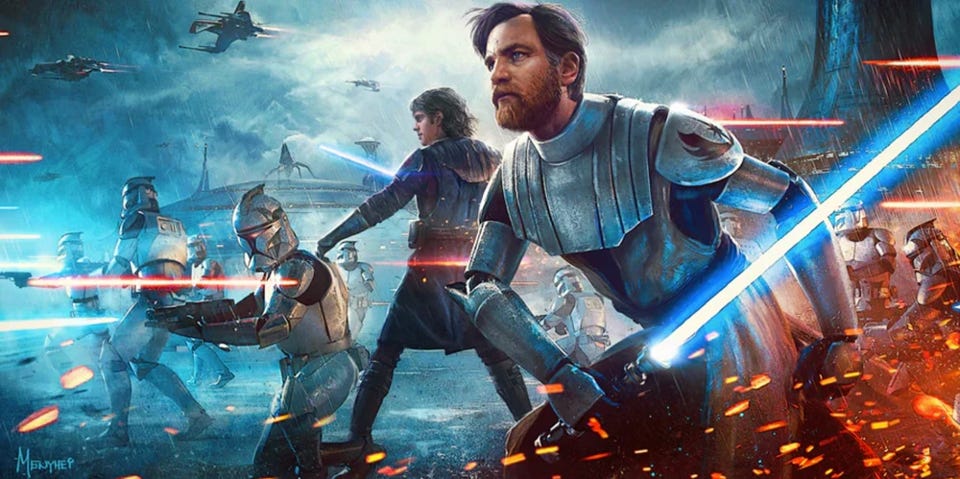

Hi. I’ve been thinking about Star Wars lately because I’m always thinking about Star Wars. It’s my Roman Empire. I was born in 1974. A New Hope (the first Star Wars movie, which we always just called Star Wars) was released in 1977, so it’s almost as old as I am. But when I say I’ve been thinking about Star Wars, I mean more than a particular movie or story; I mean the franchise. And when I say, the franchise, I mean the mythology.
When I was a kid, the Jedi were pretty cool. Space wizards? What’s not to love? Obi-Wan and Yoda seemed like decent fellows, and the hero’s journey of Luke Skywalker, to become a Jedi and rescue his father from the dark side, was pretty glorious. But I didn’t know.
I didn’t know, since it wasn’t revealed yet, that before we met those few Jedi all those years ago, the corruption of their order brought about their own downfall. Why? Because when you mix the Force and politics, you get politics. Originally an independent group of philosophers and spiritual seekers of the Force, the Jedi eventually united with the Republic for the sake of achieving some shared goals. Seemed to make sense. But in the process, they went from scholars, to peacekeepers, to diplomats for the Republic, to generals in the Grand Army of the Republic. And at the same time, their order became so institutionalized that its focus shifted from spiritual understanding to external codes and conformity. While claiming to be independent, their autonomy was lost. Their power was contained. They were co-opted by the state. And it was their own fault. In the years leading up to Luke’s birth, the Jedi treated the Republic’s enemies as their enemies, while unknowingly taking orders from a dark lord whom they could not sense was their actual enemy.
When you mix religion and politics, you get politics.
Now, don’t get mad yet. I won’t say that Christians should not participate in self-government. They should. I won’t say that our country is evil. It’s not. I won’t say that our political parties are evil, either. They’re not, but they are, you know, political. And I’m not going to single out any politicians as particularly dangerous. That would be counterproductive.
My concern is for those of us in spiritual leadership, especially those who have long held to the separation of church and state, in theory at least. I’m writing principally to pastors, elders, deacons, and even teachers and small group leaders. But in a general sense, this is every Christian’s concern.
Our unique power is found in our personal relationship with God dwelling in us, which overflows upon those we influence. Our battle is not against flesh and blood, but against spiritual forces of evil (Eph. 6:12). We march to the beat, not of human government, politics, and opinions, but of the Holy Spirit of God (Gal. 5:25).
Look, we should have good government, and it’s every citizen’s concern and responsibility to participate in that to the appropriate degree. I’m not saying to withdraw from public life altogether. I’m not even saying that Christians should not participate in politics. But I am saying that this world’s systems will be glad to break up God’s people into voting blocs and judge us based on our loyalty to their own purposes. My observation is that they will test that loyalty by asking (demanding) that we choose them over God’s people and purposes. They will say the only way to save the republic is by treating the present as such a state of emergency that we have to pick sides today so that we can enjoy a better tomorrow. Even worse, they’ll ask us to use morally compromised words and actions to secure an appearance of morality.
I see a difference between speaking to issues or voting for candidates the way you think is best, and picking a side in a way that shapes your identity. There’s something about taking sides that invests you as a winner and loser along with that group (think about your sports teams that you neither own nor play on). Over time, one can lose the ability to see the faults on the chosen side while exaggerating the faults of the other. It’s natural. We want our side to be right and to win. But human institutions will not always be right. It is up to people like us not to overlook error and compromise our convictions, but to remember our first love. God’s family does not squarely align with ethnic, national, cultural, or political categories.
So don’t be a general in someone else’s war. When the Jedi did that, they received status in the Republic but lost their power—perhaps they had already lost it. When we do that, we might receive cultural standing, identity, and influence, but lose the power of character on the real people in our lives, including ourselves—perhaps some already have.
OK, Star Wars nerds. Where did I get this right and wrong? Let me know and I’ll show you how I was, in fact, right all along!
Thoughtful political commentary from a Christian perspective without crazy kickers to try to get attention.