



Hi. I came across this post on Facebook. It lists a series of “problems” with the New King James Version of the Bible. Here’s a screenshot with the account hidden. It was not posted by a friend of mine, but it’s similar to posts I have seen from some of my friends.
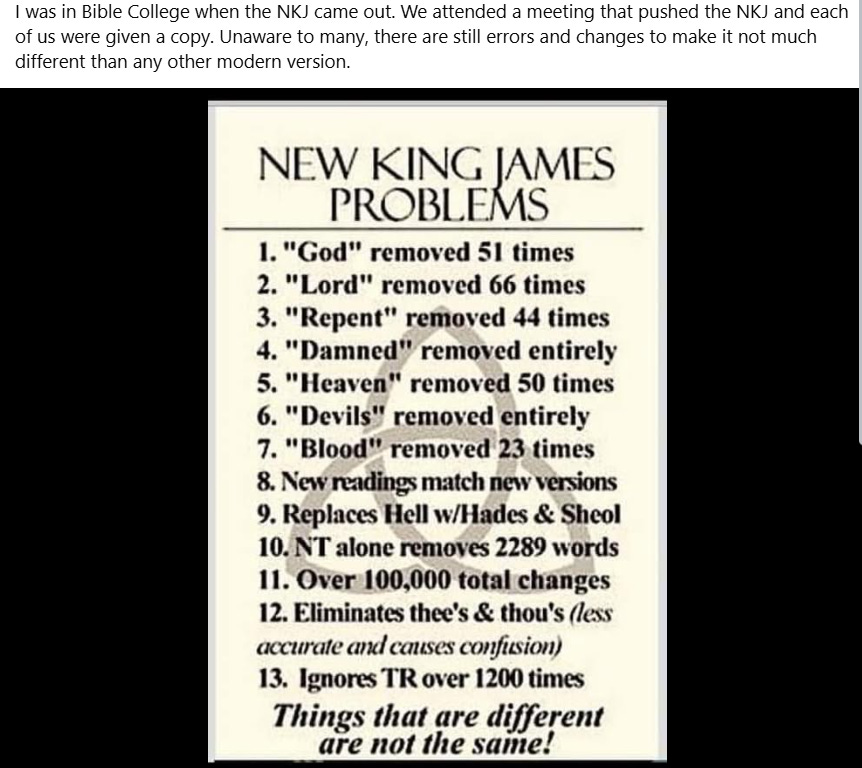
I have some problems with these problems.
It’s deliberately misleading about the translation.
Anyone who can look up words in a concordance can see that saying “the heavens” for the sky instead of “the heaven” is not a removal of the word (Ex. 9:8).
While we certainly want people to “repent” of their sins, not every change is that kind of repentance. If people turn from the right path, maybe it’s clearer to say they “change their minds” (Ex. 13:7), than “repent.”
It’s true that “devils” is not found in the NKJV, but “demons” is. The horror of such errors!
It undermines the confidence we should have in the Bible.
We have God’s word! He inspired it and preserved it throughout thousands of years. He used really smart people to convert it from its original languages to other languages. This is a fantastic blessing. There’s no need for God to stop the translations at any time. As languages change, so do the translations.
And by the way, we all know that post wasn’t just about the NKJV, right? If someone’s anti-New King James, you know how they feel about all modern translations.
Hey! I’m not saying that ALL Bible translations are great. But I am saying that the most common ones we see in evangelical churches, those most used by curriculum publishers, and Christian authors, are reliable and you can have confidence in them as the word of God.
Want some more on this? Here’s a two-parter on the different Bible versions.


It undermines the confidence we should have in the church.
Posts like the one in that pic imply that if you do not hold the line on the right Bible version, the church will crumble and Christianity will wither and die. The truth is that some local churches will die and some will thrive, regardless of the translations they use.
It also implies that the church cannot stand if people in the same local church use different versions. That’s just false. Unity and uniformity are two different things. If a church’s people use a combination of the KJV, NKJV, ESV, NIV, NASB, CSB, NLT, plus some others like RVR 1960, it will be fine.
The impact of the differences has been disproven.
Guys, I’ve been seeing things like this my whole life. (The NIV was first published in 1978, NKJV in 1979.) The idea is that these modern versions will gradually cause their readers to deny orthodox theology and slide into error and worldliness. It’s just not my observation that serious Christians and churches who use modern versions have turned their back on the faith.
Take heart.
OK, this feels a little negative and I don’t want that. Deep down, these kinds of things bother me because I want you to be encouraged and confident. So instead of arguing, when you see these kinds of knocks on Bible versions, just click the X at the top right of the Facebook post and get it out of your feed, knowing God’s word and God’s Spirit can handle honest differences in translation. And so can you.