


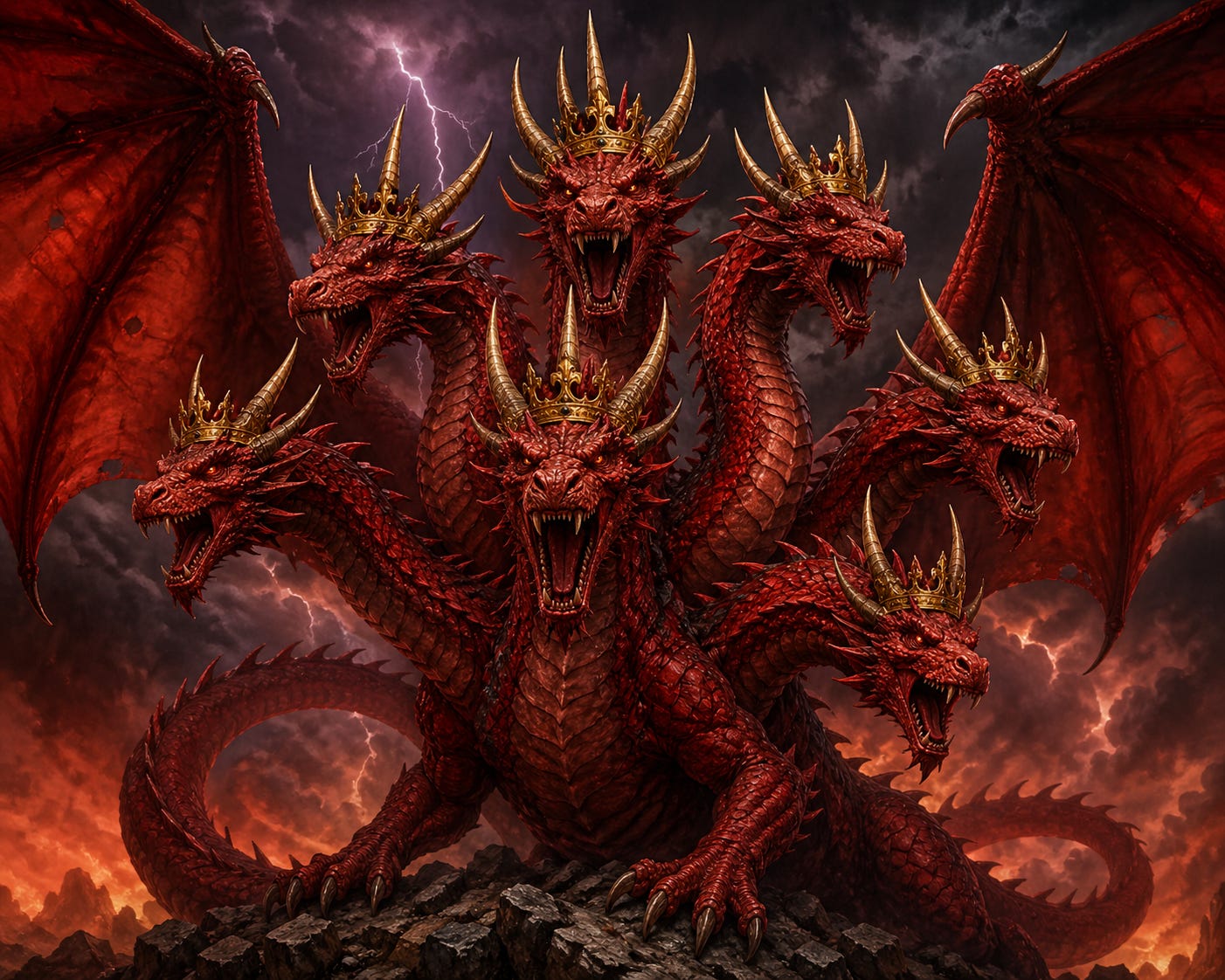
Hi. The following is an excerpt from the new commentary, Revelation: The Consummation of All Things. The section here is a part of my contribution, “THE DRAGON WARS: Revelation 12:1-17.” If you’re from my church or local to me, can get you a copy here, for a little while. But if I don’t often see you, the book will soon be available on Amazon. I’ll post that link when I get it. (Update: It’s there now.)
A word about timing: Discussion of the chronology of Revelation 12 is not included in this excerpt. I will, however, add some extra thoughts at the end.
The Dragon War in Heaven (7-12)
And there was war in heaven: Michael and his angels fought against the dragon (v7).* While it is indeed spiritual warfare, this war in heaven is fought between the Archangel Michael with his angels and Satan with his. It is the direct fighting of angelic beings; it is not the indirect warfare of believing saints (v11). The presence of Michael is further support for the Israel-centric nature of the passage. Michael is the patron angel of Israel (Dan. 10:13, 12:1; Jude 9) and his fight against Satan here suggests a fight for Israel’s survival during the latter half of the tribulation. “Apparently, the devil’s hatred of Israel will spur him to make one final assault against the throne of God, but he will be defeated by Michael and a heavenly host” (Wiersbe, p. 603).
Since Satan’s power cannot rival God’s, Satan was defeated. He only has dominion over what God permits, when God permits it. What is more, he also only has access to where God permits, when God permits it. And his time in heaven was up. Verse 9 presents the seriousness of this judgment. Three times the verse says that Satan and his angels were cast out from heaven to earth (see notes on v4).
The dragon is named or described here in five ways: the great dragon…that old serpent, called the Devil, and Satan, which deceiveth the whole world (v9). The use of dragon in the OT as a threat to Israel has already been discussed. The old serpent is that same creature who used words to confuse, deceive, and tempt Adam and Eve in the garden (Gen. 3). Devil means “slanderer,” and Satan means “adversary” (c.f. Job 1, also in heaven). Fifth, as if John has not put too fine a point on it, Satan is the deceiver of the world. If the Devil makes war, then these are five ways to describe his tactics. He terrorizes, twists the truth, slanders, opposes, and attempts to deceive everyone he can, both in heaven and on earth. Important is Satan’s critical use of words in these descriptions (see also “accuse” in v10). Indeed, words are his primary weapon, at least as he is presented here, and—to preview the message to come in v11—the word will be the defense of believers against him.
The rest of the section, verses 10-12, are an announcement from a loud voice saying in heaven. The loud voice is common in Revelation, typically denoting an announcement or command coming with divine authority (1:10, 5:12, 10:3, 11:12). The voice proclaims the era of salvation, and strength, and the kingdom of our God, and the power of his Christ. “The work of Christ on the cross provided the basis for salvation in Christ’s atoning death, but salvation is not ultimately finished until Satan and evil are destroyed, the saints are glorified, and the heavenly state in its purity is established” (Patterson, p. 267-268). This triumph is brought into sharper focus with each progressive step in Revelation toward the second coming of Christ, this step being when the accuser of our brethren is cast down, which accused them before our God day and night. Again, Satan’s use of words is the key to understanding his tactics. “From his portrayal in the book of Job on, Satan is presented as an accuser of the righteous, a prosecuting attorney before God’s court. In later texts, his role of tempter (gaining incriminating evidence) became more prominent, but he always retained his role as accuser; later rabbinic texts declared that he accused Israel day and night before God, except on the Day of Atonement” (Keener, p. Re 12:10). Here, with his being “disbarred,” as it were, no longer given the opportunity to accuse believers at God’s court, he has lost the war in heaven. He will still make war on the earth, but before moving the reader’s attention there, the loud voice in heaven still has something to say about believers, the heavens, and the earth.
Regarding the brethren of verse 10, or tribulation believers, they overcame him by the blood of the Lamb, and by the word of their testimony (v11). This verb “to overcome” or “to conquer” is used 17 times in Revelation. It is used seven times in chapter 2-3 of church age Christians, but it is also used twice for Tribulation saints who overcome Satan (12:11) and the Antichrist (15:2). It is also used for believers of all time in the new heaven and earth (21:7). So, this verse is both a divine preview of the dragon war which will come to the earth (12:13-17) and a fair restatement of Christian spiritual warfare today, standing firm in the armor of God (Eph. 6:10-17).
Christians are not called to directly fight Satan and his angels the same way Michael does (v7). Whereas much has been made of Satan’s use of words in this passage, much must be made of Christians’ use of words to overcome him. The believer’s weapon, or defense, against the slanderous attacks of the Devil is the atoning death and resurrection of Christ. “However, that weapon must be appropriated, and so the author observes that they overcame Satan ‘by the blood of the Lamb’—the effective means of redemption—and by the word of their testimony (i.e., each of the brethren confessed Christ and his atonement alone as sufficient for his salvation). On the basis of Christ’s work on the cross and their personal confession of that, the brethren overcome the accusations of Satan” (Patterson, p. 269). When facing the lies, confusion, slander, and deceit that come from the mouth of the Evil One, God’s people stand securely on the sacrifice of Christ and the word of their own confession of salvation. Further, overcoming the words of Satan with the word of God is no new idea (Mt. 4:1-10).
This fight of the saints against Satan is described from the divine perspective. From the earthly perspective, some of them will taste death, but from heaven’s view they have overcome and eternal reward awaits.
The only command of the chapter is found in the next verse. Therefore rejoice, ye heavens, and ye that dwell in them (v12). The cause for rejoicing is not the death of the faithful in the preceding verse but the expulsion of Satan and his resulting absence from heaven. This, however, would have the opposite effect on the earth. Woe to the inhabiters of the earth and of the sea! for the devil is come down unto you, having great wrath, because he knoweth that he hath but a short time. Since the Devil is aware of the timeline, and since he will have no place else to go, he will explode in anger upon the earth. This will be the subject of the final section of the chapter (12:13-17). But while some anger may come from Satan, the woe is a part of God’s wrath revealed throughout the book (6:16-17, 11:18). “The term … ‘woe,’ in the NT occurs primarily in the synoptic Gospels (twelve times in Matthew; two in Mark; fifteen in Luke), always in sayings of Jesus. The term occurs fourteen times in Revelation. In both contexts it conveys a prophetic gravity that calls to mind the great prophetic speeches of denunciation in the OT, particularly in Isaiah and Jeremiah” (Aune, p. 704). This is the third of three woes announced earlier (8:13, 9:12), and these three woes correspond with the fifth, sixth, and seventh trumpets. The three are announced in 8:13, and then the fifth trumpet is blown (9:1). After the demonic torment of that judgment, John states, One woe is past; and, behold, there come two woes more hereafter (9:12). The sixth angel sounded his trumpet, and a third of mankind were killed, and among other judgments, the ministry of the two witnesses was described. After this is written, The second woe is past; and, behold, the third woe cometh quickly (11:14). Then the seventh trumpet sounds, there is more announcement phenomena in heaven, and attention turns to the dragon as he is cast down from heaven to wage war on earth, and the great tribulation begins. This, and all that comes with it, including the revelation of the beast and false prophet, the seven vials, the fall of Babylon the great, and the second coming of Christ, is the third woe.
You may have noticed I didn’t say anything about the timing or chronology of the end times in the excerpt above. I did write about it earlier in the chapter, specifically in my introduction and in my notes on verse 6. Briefly, the three and a half year period mentioned five times in this section (Rev. 11:2-3; 12:6, 14; 13:5) is meant to correlate with Daniel 7:25 and 12:7, to indicate the final three and a half years prior to the second coming of Christ, a period Jesus called “great tribulation” (Matt. 24:21). So in Revelation 12, everything that happens after verse 6 is within this period.
(*The editorial choice of the Hebron Commentary Series was to start from the KJV, which explains why my Scripture usage there is different from what I usually use.)