


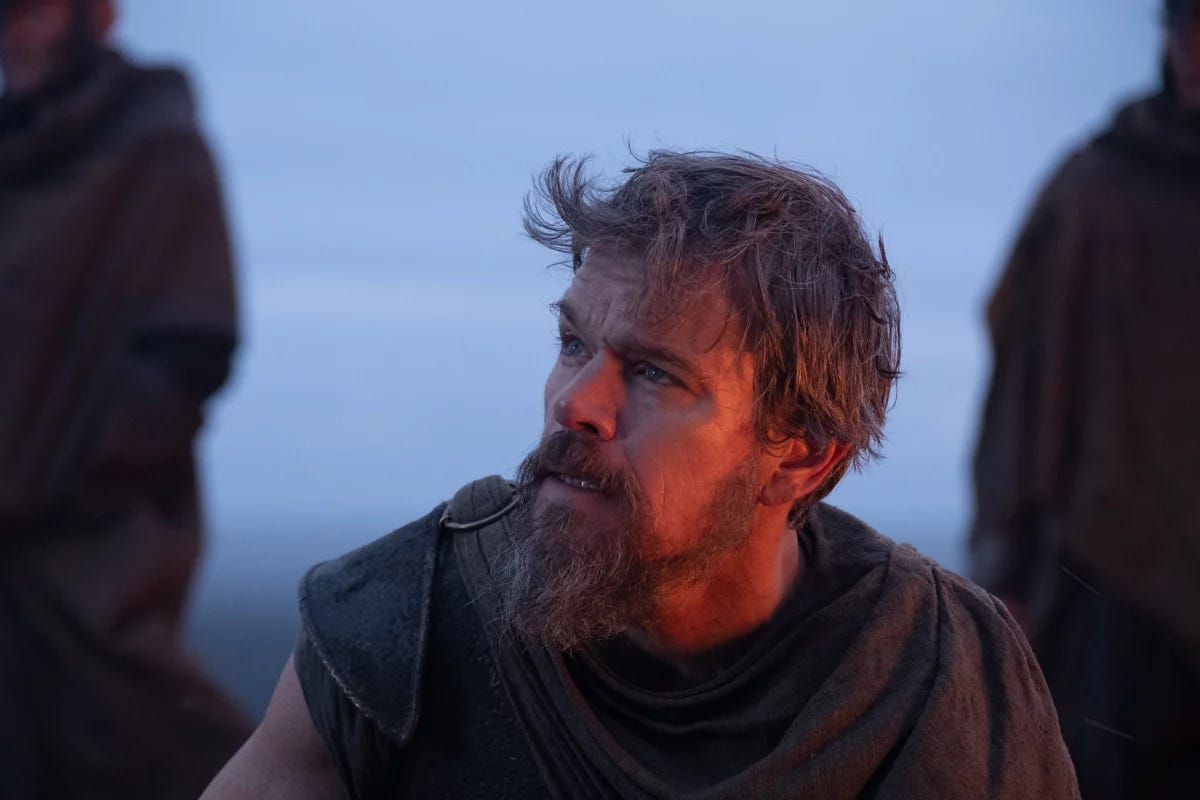
Hi. Today I want to do something a little different. I’m going to discuss Christopher Nolan’s The Odyssey, not as a film critic, and not as a movie review, but as a reflection of one Christian on a couple of ideas that bubbled up: tragedy and restitution.
Before I start, however, it’s worth noting how magnificent The Odyssey is. It’s easy to recommend and I’m sure I’ll want to see it again. There is really a lot there to chew on, which makes sense, considering it’s a retelling of a tale as old as western civilization. I’ll try not to include significant spoilers, which on the one hand ought to be easy, considering it’s an ancient story, but on the other is difficult because it really is a fresh interpretation of Homer’s work.
So here we go.
Tragedy
Odysseus is a cunning warrior and leader. Typically presented as the hero of the Trojan War, Nolan instead chooses to cast him in a more tragic light. Here, he is a man making choices that seem to be effective in the mission, while at the same time, hollowing out his identity. He thought he was a man of integrity, who lived by a code or “law,” honoring the divine. But when his party begins the journey home, he’s done taking orders from anyone, men or gods; he answers to himself.
Of course, the choice to compromise is not worth it, and the movie makes the most of this. When man becomes a law unto himself, he will rationalize the unthinkable. Short term wins seem to outweigh long term losses. The gods will not be mocked.
Odysseus’s journey then becomes a story of what happens inside a man when facing, or hiding from, one’s own shame, disgrace, and treachery. We all want special knowledge, as long as it’s not the revelation of who we really are, for that is a terror indeed.
Further, it’s not just the man, and not just his companions and family that are damaged by compromise. Civilization itself may fall with his actions. Their culture might have been great, but it was fragile. That’s a message worth considering.
In this way, citizens can’t afford to see themselves as the heroes who must compromise integrity to save the world. It’s not worth it personally, and it won’t work anyway. We cannot forget our own shortsighted ability to frame current events as a crisis that needs someone to do something, even if it’s wrong. That temptation is omnipresent, but the Christian is resolute. Evil will come but let it not be through me.
Restitution
While I’m here for the tragedy of the story, there is also an idea of restitution in The Odyssey that I cannot get on board with. One of the ways Odysseus deals with his guilt is to try to make good on his promises and to honor the people he has lost. Of course, these are good things to do, but in this context, he’s not just trying to become a better man. He’s trying to appease the gods. But who can say what becomes of man’s efforts to convince the gods of his nobility? These are still works that demonstrate trust in self, one’s own goodness, to overcome his wickedness.
Christianity leaves no place for restitution in order to become acceptable to God. Salvation requires redemption and forgiveness, acts of God, not people. The mythical gods required sacrifices from humans to grant their favor. The God of the Bible sacrificed His own son for the sake of those He already favored, because of His grace and mercy, with humankind adding nothing but the response of faith.
On last thought: This telling leaves Odysseus sailing to the west, toward the setting sun, to exile, because he could not really go home, at least not until his wounds healed. This reminds me of another hero who was last seen sailing west, toward the setting sun, not to exile but to his truest, greatest home. Frodo’s journey teaches a different lesson, that some wounds do not keep us from going home; they actually call us home.1 Until we finally reach the golden shores of the undying lands, our real and future home, some wounds cannot be wholly cured. That home is not earned, purchased, or bargained for; it is freely given to those who believe. And it keeps us looking to the day when things will finally be made right.
For an excellent treatment of this idea, see JRR Jokien, “Wounds That Cannot Be Wholly Cured.”